

Measuring is the one step that decides whether your shutters look like they belong on your house or look like an afterthought. It takes about twenty minutes with a tape measure, and because we build every pair to order, the numbers you take are the numbers we build to — down to the quarter inch.
First decide what you want the shutters to do. Decorative shutters sit flat against the wall and never move. Operable shutters swing on hinges and really close over the window. They are measured differently, so settle this before you pick up the tape.
Measuring for Decorative Shutters
Most shutters sold in this country are decorative, and there is nothing wrong with that — a good pair of wood shutters adds color, depth and shadow line to a flat wall. But decorative does not mean careless. The goal is that a passer-by never stops to think about the proportions at all.
Start with the neighborhood
Architecture is regional. Before you measure anything, take a walk or a slow drive around your area and look at houses built from similar materials to yours. In some parts of the country a 12-inch shutter beside a wide window is perfectly normal. In others, homeowners size shutters to look as though they would cover the glass. Neither is wrong. What matters is that your house looks like it belongs where it stands.
Choosing the width
Measure the full width of the window including the trim. As a rule, the shutter should be between 25% and 33% of that measurement. One width usually works for every window on the house, and that consistency is what makes the front elevation look considered rather than assembled.
| Window width (including trim) | Suggested shutter width |
|---|---|
| 24" or smaller | 9" – 9¼" |
| 24" to 28" | 12" |
| 28" to 36" | 12", 14½" or 15" |
| 36" to 40" | 14½" or 15" |
| 40" to 43" | 14½", 15" or 16½" |
| 43" to 48" | 16½" |
| 48" to 50" | 16½" or 18" |
| 50" or larger | 18", or a pair on each side |
If you want the shutters to look as though they could close over the window, aim for roughly half the width of the glass and frame only, excluding the trim. Err slightly narrow rather than wide — a shutter that looks too big for its window is far more noticeable than one that looks a little trim.
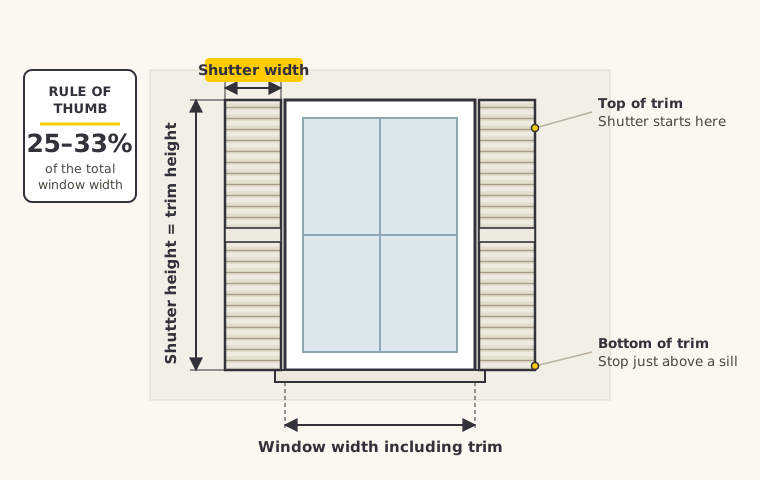
Choosing the height
In most cases the right height runs from the top of the window trim to the bottom of it. If there is a sill, stop just above it. Measure every window on the house rather than assuming: it is very common for second-floor windows to be shorter than those on the first floor, and a single wrong measurement is obvious once the shutters are hanging.
Measuring for Operable Shutters
If your shutters will actually close, precision matters more, because the pair has to meet in the middle and sit square in the opening. Windows are rarely perfectly square — especially in older homes — so you measure three times in each direction and trust the smallest number.
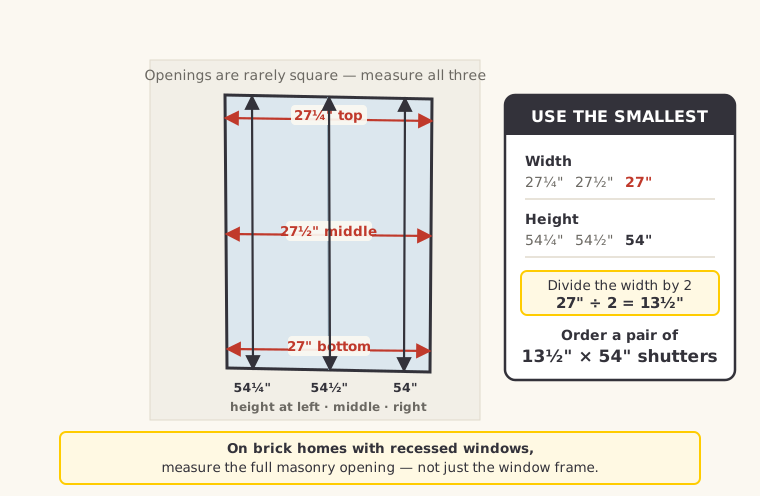
- Measure the width at three points. Left to right at the top of the opening, again at the middle, and again at the bottom.
- Use the smallest of the three. If the opening is 27¼" at the top and 27" at the bottom, work from 27".
- Divide the width in half. That is the width of each shutter in the pair. A 27" opening calls for two 13½" shutters.
- Measure the height at three points. Top to bottom at the left side, the middle, and the right side, excluding any sill.
- Use the smallest height. That measurement is the shutter height you order.
On a brick home with recessed windows, you will usually want the closed shutters to cover the whole masonry opening rather than just the window itself. Measure the opening, not the frame.
Measure twice, order once. If anything about an opening looks unusual — an arch, a bay, a window that is badly out of square — send us the measurements and a photo at sales@sunbeltshutters.com before you order. We would much rather answer a question than build a pair that does not fit.
Custom Sized to the Quarter Inch
Mass-produced shutters come in fixed sizes, which is why so many houses end up with shutters that are close to right rather than right. Every shutter we build is made to order in our own shop, so you give us the measurement you took and we build to it — to the quarter inch, in any of our woods or in Extira composite. Your shutters look like they were made for your home, because they were.
Contractors and installers get quantity pricing whether the job needs ten pairs or a thousand. If you are not sure which style suits the house, order a sample first and hold it up against the wall.
Common Questions About Measuring
- What width shutters should I order for my windows?
- For decorative shutters, a good rule is a width between 25% and 33% of the total window width including the trim. On a 36-inch window that is usually a 12-inch or 15-inch shutter. Because we build to order, we can size to the quarter inch rather than making you settle for a stock width.
- How tall should my shutters be?
- For decorative shutters, match the height of the window trim, top to bottom. If there is a sill, stop just above it. Measure every window on the house separately, as second-floor windows are often a different height from the first floor.
- How do I measure for operable shutters that actually close?
- Measure the opening at three points in each direction: width at the top, middle and bottom, and height at the left, middle and right. Use the smallest measurement in each direction. Divide the width in half to get the width of each shutter of the pair.
- Do I have to order a standard size?
- No. Every shutter we build is custom sized to the quarter inch, so you order the size your window actually is instead of the nearest size on a shelf.
- What if my windows are wider than 50 inches?
- For very wide windows, most homeowners either move up to an 18-inch shutter or use a pair on each side. Send your measurements to sales@sunbeltshutters.com and we will tell you what looks right for that opening.